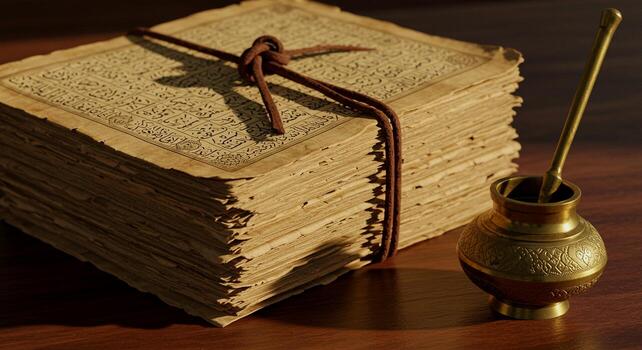
The Long Journey to the Modern Book
Long before machines could print thousands of identical books in a single day, a book was something rare, precious, and painstakingly made by hand. Imagine walking into an ancient library in Alexandria, Rome, or Athens. There are no printers, computers, or photocopiers. Instead, you hear the scratching of reeds on papyrus, the murmuring voices of readers, and the steady work of scribes copying words one line at a time. This was the ancient publishing system.
From Author to Scribe
When an ancient writer completed a work, the writing did not automatically become a book. There was no printing press to reproduce it. The author’s original manuscript, often called an autograph, could be copied by professional scribes. These scribes were trained to reproduce the text as accurately as possible.
In ancient Egypt, papyrus was one of the most important writing materials. In the Greek and Roman worlds, papyrus scrolls became an important form of literature. Later, parchment made from animal skin became increasingly common. The process was slow. A scribe had to carefully read the original text and write a new copy by hand.
One mistake could change a sentence. One missing line could change a story. And sometimes, mistakes were copied into later editions.
The Ancient “Publishing House”
Large scale book production eventually became a business. In cities such as Rome, booksellers could employ teams of enslaved or professional copyists. When a popular author released a new work, several scribes might copy the text simultaneously.
Imagine a room filled with people writing the same book. One person might read the original manuscript aloud while several others wrote down the words. This allowed multiple copies to be produced more quickly than if each scribe worked alone. The finished copies could then be sold through booksellers. In this sense, ancient books already had something resembling a publishing industry but it was completely dependent on human hands.
Libraries Were the Ancient Bookstores of Knowledge and played another important role. The most famous example was the Library of Alexandria, which became a legendary center of learning in the ancient Mediterranean world. Scholars gathered there to study literature, science, mathematics, philosophy, and history.
Ancient rulers and scholars understood something that remains true today: controlling and collecting written knowledge was a source of enormous power. Books could travel across cities and kingdoms. A work written in one place could be copied somewhere else and eventually reach readers thousands of miles away.
But every new copy also introduced the possibility of change. Ancient books did not have modern distribution networks. Instead, they moved through merchants, travelers, scholars, students, soldiers, religious communities, and political connections. A scholar might obtain a copy of a famous work while traveling and take it home. Another scribe could copy that version. A bookseller could then sell the new copies.
Over decades or centuries, the same work might exist in many slightly different versions. This is one reason historians today sometimes find different readings of ancient texts.
The Birth of the Codex
For much of antiquity, books were commonly made as scrolls. But eventually another format became increasingly important: the codex. A codex resembles the basic structure of a modern book, with separate pages bound together along one side. The codex had major advantages. Readers could turn directly to a particular page, write notes more easily, and carry a collection of texts in a compact form. By late antiquity, the codex had become especially important among Christian communities, and it gradually transformed the physical experience of reading.
The book was becoming more like the object we recognize today. Why Ancient Books Were So Valuable?Today, producing a book can be remarkably cheap. In the ancient world, producing a book required time, materials, skilled labor, and money.
A wealthy household might own a personal library. Scholars depended on access to collections of texts. Religious communities carefully preserved sacred writings. For ordinary people, however, books were much less accessible than they are today. Literacy itself was also unevenly distributed, meaning that written culture was concentrated among particular social groups.
A Fragile Publishing System
The ancient publishing system had one enormous weakness: a book could disappear very easily. If there were only a few copies of a work and those copies were destroyed, the text could vanish permanently. Fire, war, decay, political upheaval, and simple neglect all threatened ancient literature. Thousands of works known to have existed in antiquity have been lost. What survives today is therefore only a fraction of the enormous world of ancient writing.
The Long Journey to the Modern Book
The ancient world did not have printing presses, mass-market bookstores, or online publishing platforms. Yet its publishing system contained many of the same basic ideas we recognize today: Someone created a text. Someone reproduced it. Someone distributed it. And someone preserved it for future readers. The technology was different, but the purpose was remarkably familiar.
Every ancient manuscript that survived represents a chain of human effort: an author who wrote the words, a scribe who copied them, a reader who valued them, and someone who preserved them long enough for another generation to discover them.
So the next time you pick up an inexpensive modern book, remember that the journey of the book began thousands of years ago with a sheet of papyrus, a sharpened reed, and a patient hand writing one word at a time.